Solflare to compensate staking rewards after Solana validator outage
Solflare promised to cover missed rewards after a security incident at an external provider took its staking validator offline.
 By Redacción Crypto InformaReading time: 3 min
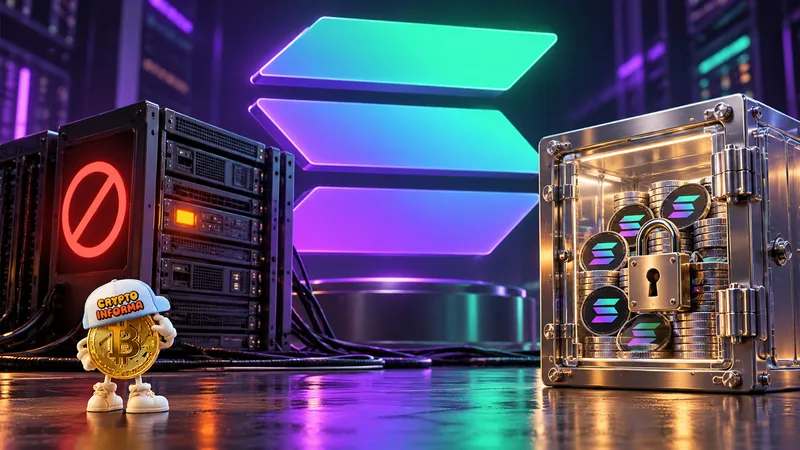
Solflare announced it will compensate Solana users for missed staking rewards after a security incident at an external provider took the validator associated with its application offline. The episode, reported from October 27, 2026, affected reward production, but the company said customers' delegated SOL were not stolen.
Reported data showed around 1.56 million SOL remained delegated to the affected validator, equivalent to roughly US$160 million at prices cited in October 29 coverage. That figure represents the approximate value of assets assigned to the node, not stolen funds or the amount of rewards to be compensated.
What happened to the validator
Solflare said the company hired to operate the validator notified it of an incident involving the keys used by that service. The organization did not publicly identify the provider in the cited statements and said it was investigating. The validator's suspension temporarily interrupted reward generation.
Staking allows tokens to be delegated to validators participating in a proof-of-stake network. Active validators verify information and receive rewards that are distributed according to protocol rules and service conditions. If a node stops operating correctly, users may stop receiving that income.
On Solana, delegated assets remain in staking accounts controlled by the user's keys. An entity managing the validator's operational keys cannot, on that basis alone, withdraw tokens from delegators' accounts. That is why Solflare distinguished the interruption of rewards from a loss of deposited capital.
The incident also highlighted the role of external providers in services presented under a wallet's brand. Although users interact with a single application, different companies may be responsible for important parts of the infrastructure.

How migration will work
Solflare said it launched a replacement validator and that users can move their delegation from the previous option, identified as Solflare Legacy, to the new one. The company promised to cover missed rewards for those completing that migration, but said it would still detail the exact period and calculation method.
Reallocating staking is not always instantaneous. Changes may depend on the end of Solana epochs, periods lasting approximately two days. During the process, the stake may continue generating no rewards even though the tokens have not left the user's account.
The wallet emphasized that migration must take place within its own application and that it will not send private messages or links requesting it. The warning aims to reduce scams exploiting confusion and asking users to enter recovery phrases on outside sites.
The security challenge in outsourced services
Solflare now faces two separate tasks: stably restoring validator operations and explaining how it will compensate users' missed rewards. Until all details are known, it is incorrect to present a total compensation figure.
The situation matters to operators and businesses contracting blockchain infrastructure because it exposes third-party risks. Capital custody can remain secure while a failure involving operational keys affects service availability and related income.
For users in Argentina and Latin America, the main practical point is to distinguish the delegated balance from rewards that stop being generated. Before making changes, users should verify announcements through the application's official channels, without using links received from strangers.
The Solflare case shows that security on a decentralized network does not depend on a single key or company. The incident's progress will be measured by validator recovery, the announced compensation and final information about the technical causes.
Tags
This is information, not financial advice. Before deciding, compare sources and consider your own situation.