Solana vs Ethereum: differences, fees and uses of each network
Solana vs Ethereum compares two networks capable of executing smart contracts, but with different infrastructure designs. Solana targets low…
 By Redacción Crypto InformaReading time: 4 min
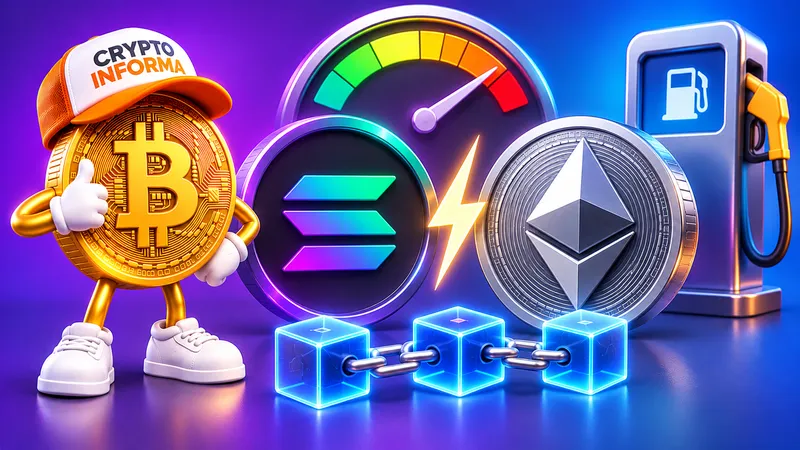
Solana vs Ethereum compares two networks capable of executing smart contracts, but with different infrastructure designs. Solana targets low-latency transactions within a high-performance main network; Ethereum combines its base layer with layer-2 solutions. Actual costs depend on the transaction and timing.
What each one is
Ethereum is a blockchain platform that uses ETH to pay gas fees and validate through proof of stake. Solana also supports applications and digital assets, and uses SOL to pay network fees. Both have executable programs, wallets and tokens, but the networks are not interchangeable: an address, token format or contract compatible with one should not be assumed valid on the other.
For more on these concepts, see Solana upgrades and Ethereum's technical roadmap.
Key differences
Comparing Solana vs Ethereum requires reviewing the context of each transaction. The difference between Solana vs Ethereum lies in architecture. Ethereum prioritizes a base network with a broad contract ecosystem and a scaling strategy based on rollups or layer 2s. Solana concentrates much of its performance on the main network. Solana transactions pay a base fee and may include a priority fee; Ethereum charges gas that varies with the work performed and demand. A permanently fixed speed or cost should not be promised.
For more on operational differences, see wallet features on Solana and tokenization in that ecosystem.
Point-by-point comparison
- Use — Solana: applications and payments in its ecosystem / Ethereum: applications and assets on the base network and its layer 2s.
- Risk — Solana: application failures and network operations / Ethereum: contract, bridge and additional-layer risks.
- Costs — Solana: base fee in SOL and optional priority / Ethereum: gas in ETH; layer 2 uses a different structure.
- Speed — Solana: low-latency design / Ethereum: base-layer timing and finality, with L2 alternatives.
- Control — Solana: validators and protocol rules / Ethereum: PoS validators, clients and community governance.
- Compatibility — Solana: its own assets and programs / Ethereum: EVM and a broad ecosystem of compatible contracts.
Advantages and disadvantages of each
Solana facilitates applications that need frequent transactions with generally small fees, but developers and users must understand network availability, congestion and wallet compatibility. Ethereum has an established ecosystem of tools, protocols and scaling solutions, although using the base layer can be more expensive during periods of demand, and using bridges adds risks.
For more on advantages and limitations, see differences between token networks and contract compatibility proposals.
Which uses each is better suited to
For a product requiring many short interactions, it is useful to assess an application's actual performance on Solana and compare it with different Ethereum layers, rather than only the main network. For contracts already designed for the EVM virtual machine, technical compatibility is relevant. For individual users, many transactions depend more on the specific wallet and platform than on the blockchain's name.
What to consider in Argentina and Latin America
A transfer equivalent to $20.000 in Argentina can face very different costs depending on the network, chosen token and intermediary. Before withdrawing, users must check that the destination and source support exactly the same blockchain and token version. A low fee does not offset the risk of sending assets to an incompatible address or using an unfamiliar bridge. Peso quotes also include a conversion spread.

For more on the local situation, see the institutional ETH market and an example of payments on Solana.
Conclusion
In summary, Solana vs Ethereum requires assessing specific objectives. The Solana vs Ethereum comparison produces different answers depending on the application: Solana emphasizes direct network performance; Ethereum emphasizes programmable infrastructure and expansion through layers. There is no universal advantage independent of measured costs, security, compatibility and specific needs.
Frequently asked questions
Are SOL and ETH the same cryptocurrency?
No. They are native assets of different networks and are used to pay fees in their ecosystems.
Is the fastest network always the most secure?
No. Speed, decentralization and security are assessed using different metrics and risks.
Does Ethereum have layer 2s?
Yes. Various networks batch transactions and publish data or proofs linked to Ethereum.
Does Solana charge fees in SOL?
Yes. Transactions require a base fee and can add an optional priority fee.
Can I send Solana tokens directly to Ethereum?
Not as if they were the same chain. Any movement between networks requires a compatible mechanism with its own risks.
What should I check before using an application?
Contract security, the exact network, total costs, liquidity, a compatible wallet and operational risks.
Tags
This is information, not financial advice. Before deciding, compare sources and consider your own situation.